Customer Spotlight: Prof. Daniel Zoccal

São Paulo State University (UNESP), Araraquara, Brazil
How does disrupted breathing affect cardiovascular health? At São Paulo State University (UNESP) in Araraquara, Brazil, Prof. Daniel Zoccal and his team are investigating how the brain coordinates breathing and circulation, and how those relationships can change across the lifespan.
His Autonomic and Respiratory Neuroscience Laboratory combines measurements of breathing, nerve activity and blood pressure with local brain oxygen and blood flow recordings. Oxford Optronix OxyLite™ and OxyFlo™ systems help the team study tissue conditions alongside the wider cardiorespiratory response.
Early breathing and cardiovascular health
One strand of the group’s work asks whether breathing disturbances in early life can have lasting effects on cardiovascular control. In a 2023 study in the Sleep journal, Dr. Zoccal and colleagues found that intermittent hypoxia during early postnatal life increased sympathetic activity and blood pressure in rats, with effects persisting into adulthood. The changes were linked to altered activity in brainstem neurons involved in controlling blood vessels.
In a 2026 study in The Journal of Physiology, Beatriz N. Vieira, Dr. Zoccal and colleagues studied spontaneously hypertensive rats from birth. New-born animals showed irregular breathing, low blood oxygen, and reduced brain oxygen levels before hypertension developed. Early hypoventilation was associated with higher blood pressure in adulthood.
Exposure to 50% oxygen during the first two weeks of life reduced neonatal breathing irregularities and later sympathetic vasoconstrictor tone but did not lower adult blood pressure. The findings help define how early respiratory dysfunction may influence cardiovascular control.
Measuring brain oxygen and blood flow
To understand how breathing and circulation affect the brain, the team follows several physiological signals together. Depending on the experiment, these include airflow, ventilation, respiratory muscle activity, blood pressure, heart rate and oxygen saturation, alongside cerebral oxygenation and blood flow.
OxyLite sensors measure local tissue oxygen partial pressure (pO₂), while OxyFlo uses laser Doppler flowmetry to follow relative changes in microvascular blood flow. These measurements provide different information from oxygen saturation, which describes how much haemoglobin is carrying oxygen. Together, they help researchers relate the whole-body response to conditions at the measurement site.
In the 2026 study, the team used OxyLite to measure brain tissue oxygen, with signals recorded through ADInstruments PowerLab and LabChart. PowerLab provides data acquisition hardware, while LabChart software allows the physiological recordings to be viewed and analysed together on a PC. This helps the team examine changes in brain oxygen alongside the respiratory and cardiovascular signals collected during an experiment.
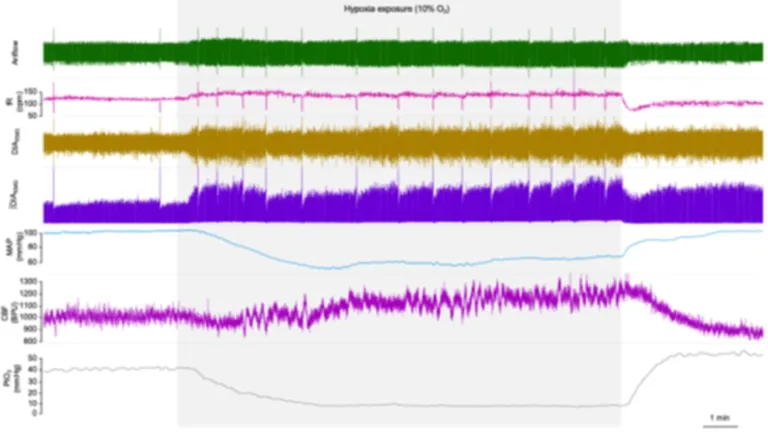
Figure 1. Data provided by Dr. Zoccal. Simultaneous cardiorespiratory and cerebral recordings in an anaesthetized animal during exposure to 10% oxygen for 10 minutes, indicated by the shaded region. The traces represent the simultaneous recording of airflow, respiratory rate, diaphragm electromyography, mean arterial pressure, cerebral blood flow, and brain tissue oxygen partial pressure.
For scientists planning similar experiments, the Oxford Optronix Device Enabler for LabChart provides a way to bring the systems together. It supports a direct digital output from OxyLite and OxyFlo monitors into LabChart software alongside recordings from PowerLab. Researchers can therefore view tissue oxygen and blood flow measurements in the same recording environment as signals such as breathing and blood pressure.
Looking across the lifespan
For Dr. Zoccal, training researchers and collaboration are closely tied to the science:
“Science isn’t done alone. It’s important to have your own identity and research focus but understand that research is multidisciplinary. Collaborating is extremely important for broadening the scope of your study.”
Dr. Zoccal’s group continues to connect questions about breathing with their consequences for cardiovascular health. Oxford Optronix is pleased to support this work with measurements that help researchers investigate oxygenation and blood flow in the brain.
To learn more about the group’s research, visit Dr. Zoccal’s Lab webpage.
If you are planning similar cardiorespiratory studies, contact Oxford Optronix to discuss how tissue oxygen and blood flow measurements could benefit your research.
Publications
Vieira BN et al. (2026).
Breathing irregularities and postnatal hypoxaemia in an experimental model of essential hypertension.
The Journal of Physiology
Karlen-Amarante M. et al. (2023).
Sympathetic dysregulation induced by postnatal intermittent hypoxia.
Sleep
Article based on an interview with Dr. Daniel Zoccal and shared by ADInstruments. The photograph and figure were provided with the interview.
View all spotlight articles